
Engineered stone
Quartz countertops for Las Vegas homes
Calder fabricates and installs quartz countertops in Henderson and across the Las Vegas valley, with one team from concept to completion. The price of a quartz countertop depends on the slab, the layout and the edge profile, plus details like sink and cooktop cutouts. That is why we write a formal quote for each project instead of posting a number that wouldn’t match your kitchen. If you’re still comparing quartz with other materials, our materials guide is a good place to start.
Engineered stone
What quartz countertops are made of
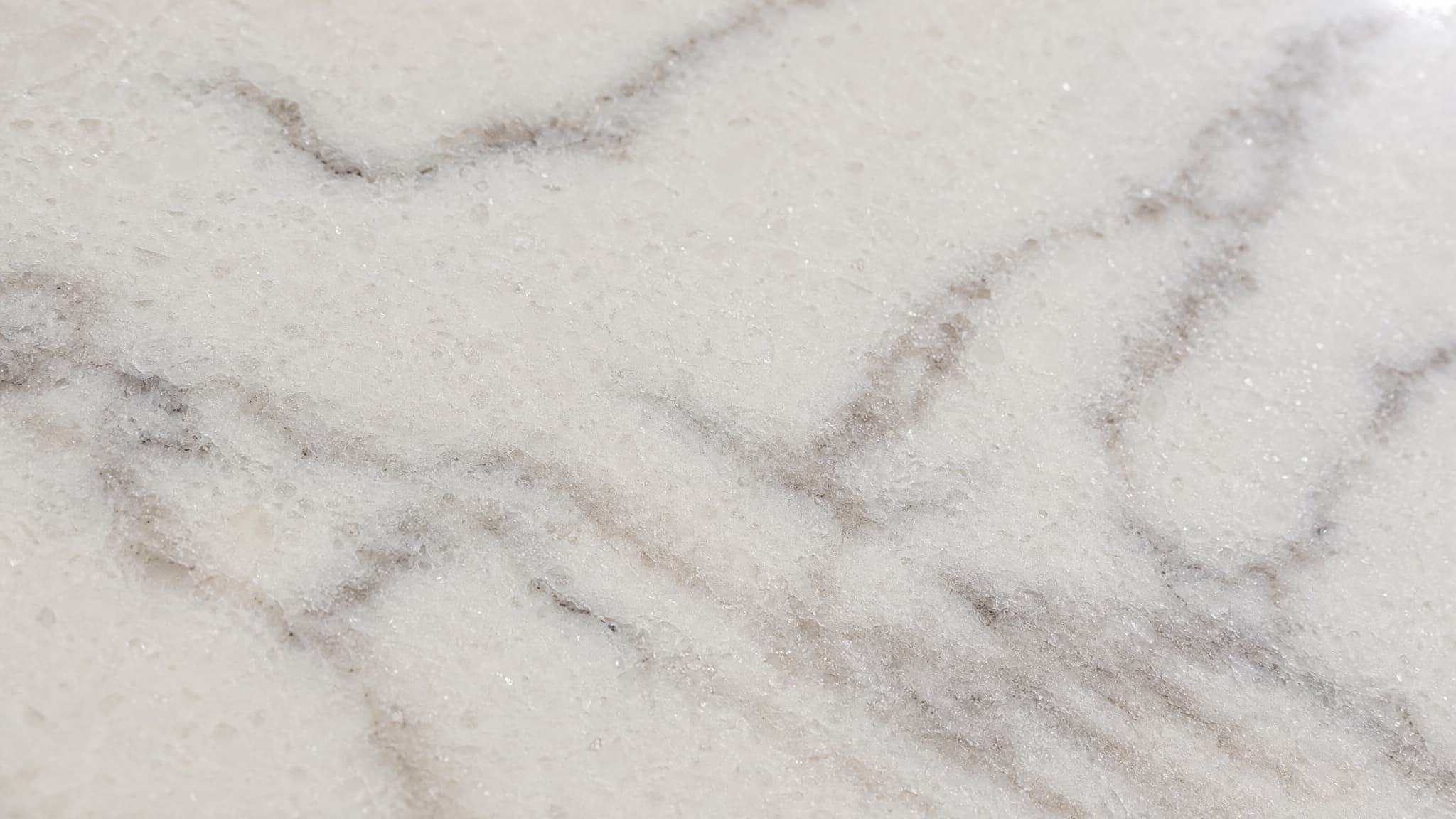
Quartz is engineered stone. Crushed natural quartz is mixed with resin and pigment, then pressed and cured into a slab. Because of that, the color and pattern stay the same from one end of an island to the other. On a natural stone slab the pattern shifts across the piece. Engineering also gives quartz a much wider range of colors and finishes than anything quarried, from bright whites with fine veining to deep, even stone tones that look convincing next to natural marble or granite.
In its favor
Why homeowners choose quartz
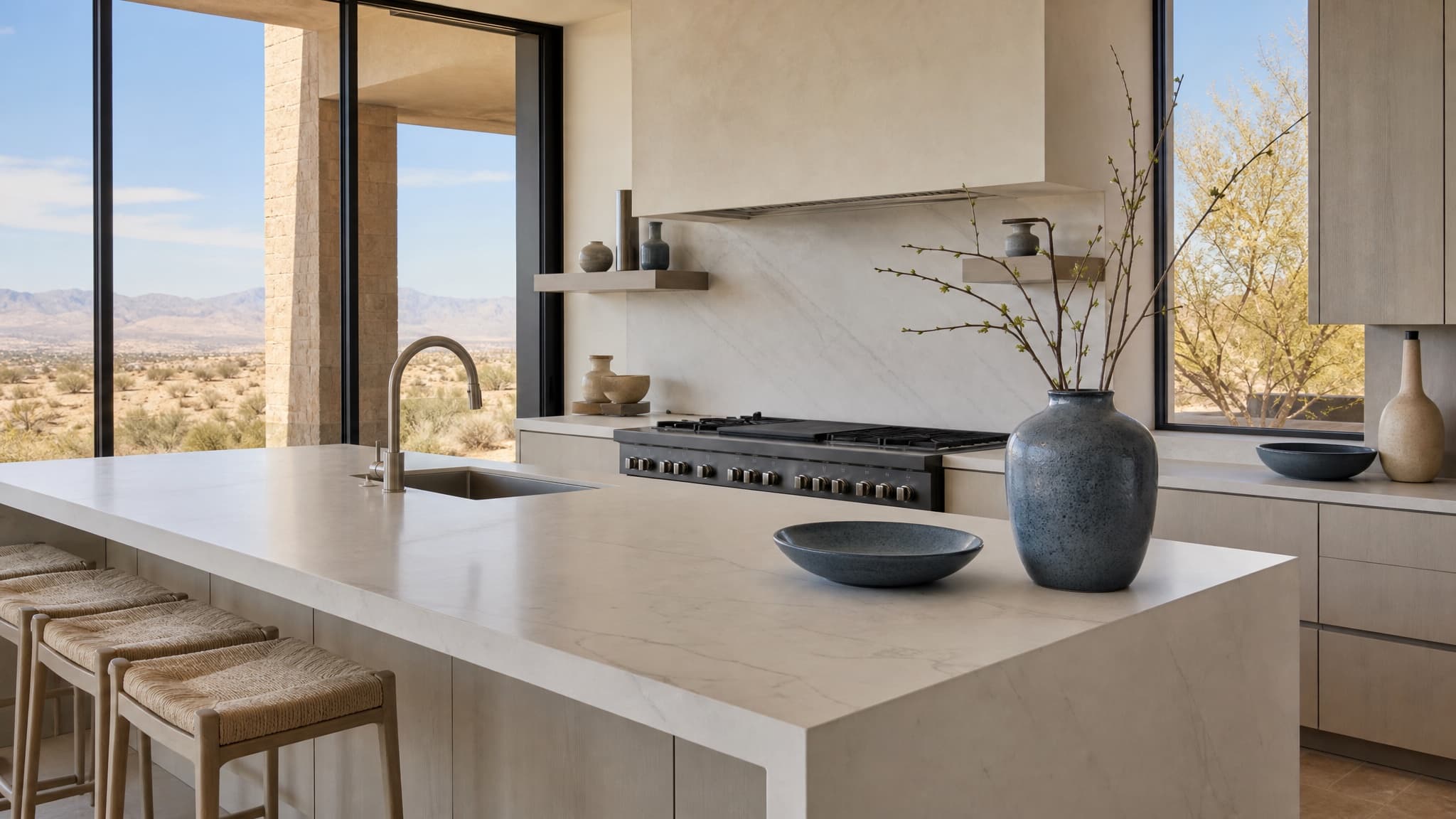
More colors and patterns than any other surface we cut. Quartz is engineered, so it comes in far more colors and patterns than any natural stone. Some large-format designs are made specifically for a waterfall island edge, where the pattern has to run unbroken down the side. That is harder to pull off with a natural slab, because its pattern shifts from one end to the other.
It never needs sealing. The resin binder keeps spills on the surface, so they wipe off. You have no yearly reseal to remember, and there is no porous stone underneath for an oil stain to soak into over the years.
We are certified on Caesarstone and Cambria, so the warranty holds. Calder is certified on both Caesarstone and Cambria, the two leading engineered quartz brands. Each brand gives its full lifetime warranty only when a certified fabricator installs the countertop, which is why the certification matters to you as the homeowner.
The color stays the same from slab to slab. The color you pick is the color that shows up in your kitchen. Engineered manufacturing removes the natural variation that sometimes surprises people who buy mined stone. That matters most on a large island or a long run of cabinets, where a pattern change between two slabs would be easy to see.
One crew fabricates and installs it. The same team fabricates and installs every quartz slab, working out of our own shop. Nothing gets handed off to another company along the way, and you have one point of contact if anything needs adjusting after the template is cut.
It handles a kitchen that gets used every day. Quartz resists scratches and everyday wear from knives, pans and normal family traffic better than most natural stone. You can put it in a busy family kitchen and use it without babying it.
One limitation
Quartz countertops belong indoors
Quartz is one of the toughest countertop materials you can buy, and it has one real limitation: direct sun fades it. UV light breaks down the resin binder over time, which dulls the color and can eventually damage the surface itself. That makes quartz an indoor material, for kitchens, bathrooms and fireplace surrounds that don’t sit in a sun-facing window. If your project has both an indoor kitchen and an outdoor cooking area, quartz can cover the inside while granite or Dekton handles the outside.
Design
Choosing a quartz color and edge profile
Quartz gives you more design range than almost any other countertop material. Manufacturers make colors and veining that don’t occur in nature, along with patterns that closely copy marble or granite. A few things are worth deciding early, before you pick a slab:
Edge profile. A simple eased edge keeps the look quiet. A mitered waterfall edge carries the pattern down the side of an island, and it works well on quartz because the pattern repeats predictably from slab to slab.
Backsplash matching. We can run quartz up the wall as a full-height backsplash cut from the same slab. The pattern then continues from the counter to the wall with no seam at the counter line.
Sink and cooktop cutouts. We plan undermount sinks, drop-in sinks and cooktop cutouts at the digital layout stage, so each cutout lands where it won’t interrupt the pattern or weaken the slab.
We go over these choices with you before anything is cut.
Upkeep
Caring for a quartz countertop
Quartz needs very little from you day to day. Wiping up spills with a damp cloth and mild soap is usually all the maintenance a quartz countertop needs. A few things to avoid:
- High heat that sits for a long time, like a hot pan set down off the burner and left there. Quartz handles brief contact fine. A trivet is still a good idea for anything that stays hot.
- Bleach or harsh, high-pH cleaners used again and again, which can dull the finish over time.
- Cutting right on the counter. Quartz resists scratches well, and a cutting board still protects both the knife and the surface.
Beyond that, there is no sealer to buy and no yearly upkeep to schedule.
In the shop
How we fabricate quartz
An engineered slab is consistent all the way through, so quartz cuts and polishes predictably on our five-axis bridge saw. There are no natural fissures to catch us out mid-cut. We cut your slab to the kitchen’s exact measurements, so it fits exactly, with no gaps at the wall or the cooktop cutout. One crew cuts, polishes and installs every quartz countertop we fabricate. See the fabrication shop.
Start my quoteStep by step
From slab to install
Every quartz project runs through these four steps. The full walkthrough, from your first call to the check after install, is on our process page.
Start your quote.
Tell us about the project and we put together a price.
Choose your slab.
Pick the exact slab that becomes your countertop.
Digital layout approval.
Review and approve the layout before we cut.
Fabricate and install.
The same crew that cut your slab installs it.
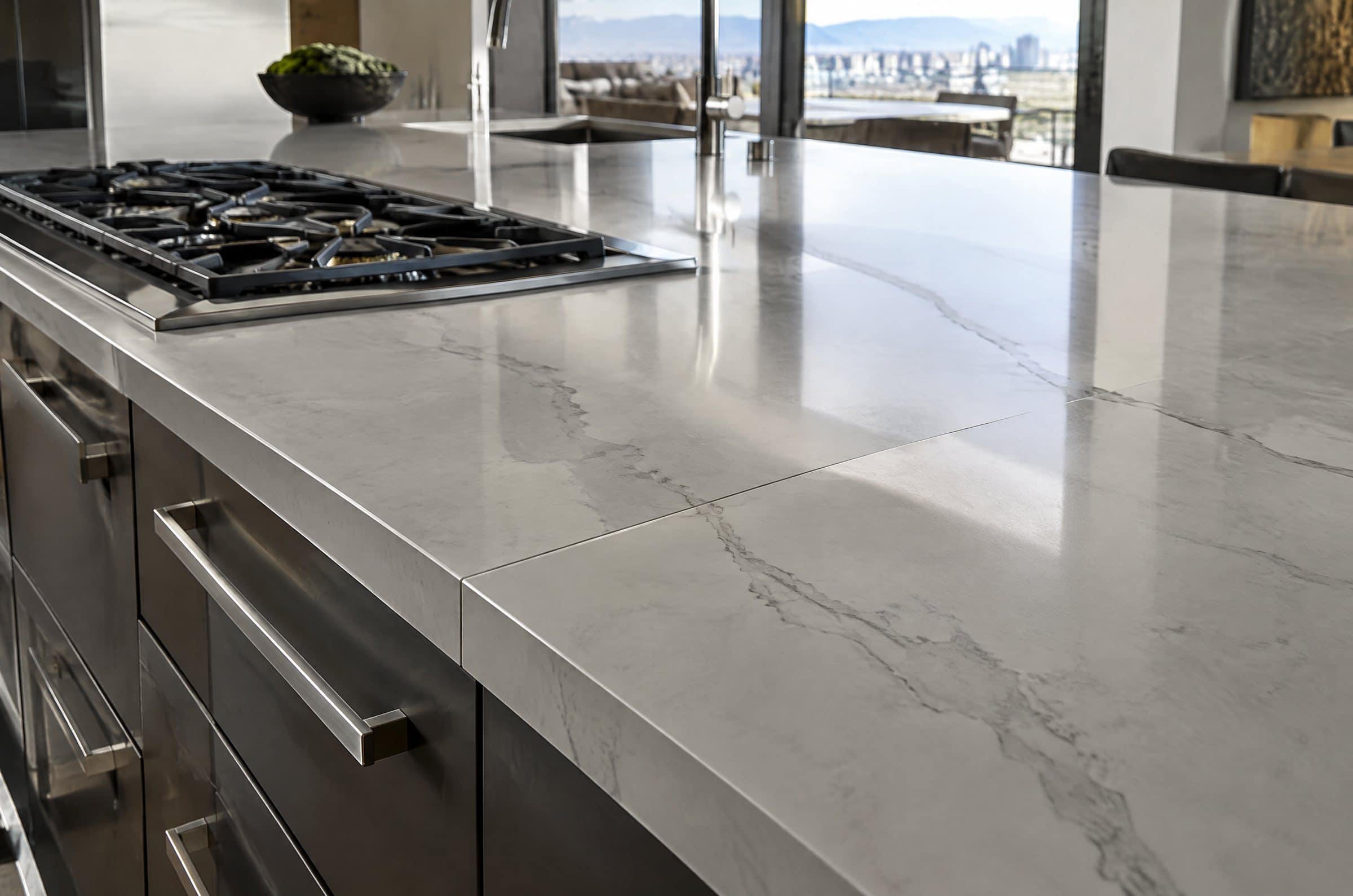
Quartz, seam and edge detail
Around the house
Where quartz works in your home
Quartz is the most common choice for kitchen countertops, a strong option for bathroom vanity tops, and a clean look for an indoor fireplace surround or feature wall, as long as it stays out of direct sun. For the same reason, quartz is the wrong material for an outdoor kitchen or BBQ surround. If your project includes an indoor kitchen and an outdoor cooking area, we can help you plan which material goes where.
Answers
Quartz countertop questions
- Is a quartz countertop natural stone?
- No. Quartz countertops are engineered stone, made from crushed natural quartz mixed with resin and pigment, then pressed and cured into a slab. Quartzite is the natural stone, quarried from the ground. The engineering is what keeps a quartz slab’s pattern and color consistent from one end to the other.
- Can I use quartz outdoors in Las Vegas?
- No. Direct sun fades quartz over time, so it belongs indoors. For an outdoor kitchen or BBQ surround, granite and Dekton both handle full Las Vegas sun and summer heat without fading.
- Does quartz need to be sealed?
- No. The resin binder in engineered quartz means the surface never needs sealing. Wine, oil and acidic foods wipe off without staining, and you skip the yearly sealing that natural stone needs.
- How are seams handled on a quartz countertop?
- We plan seams at the layout stage, before anything is cut, so the pattern lines up and the joint lands where it is hard to see, such as next to a sink or cooktop instead of the middle of an island. A properly cut and set seam fits exactly, with no gaps. It is sealed with a color-matched seam adhesive that keeps the joint tight and nearly invisible.
- Is Caesarstone or Cambria a better quartz brand?
- Both hold up well in daily use. The choice usually comes down to the colors and patterns each brand offers that year and the terms of each brand’s warranty. Silestone is the other quartz name homeowners tend to recognize, and you would compare it the same way. Caesarstone and Cambria are the two brands Calder is certified on, so either one keeps its manufacturer warranty intact when we install it.
- What edge profile works best with quartz?
- Quartz takes almost any edge profile, from a simple eased edge to a mitered waterfall down the side of an island. Because the pattern is consistent across the slab, a waterfall edge lines up cleanly. That is harder to guarantee with some natural stone.
Specifying for a client? Visit our trade page.